

The Urban Room: Rethinking Adaptive Reuse After Demolition
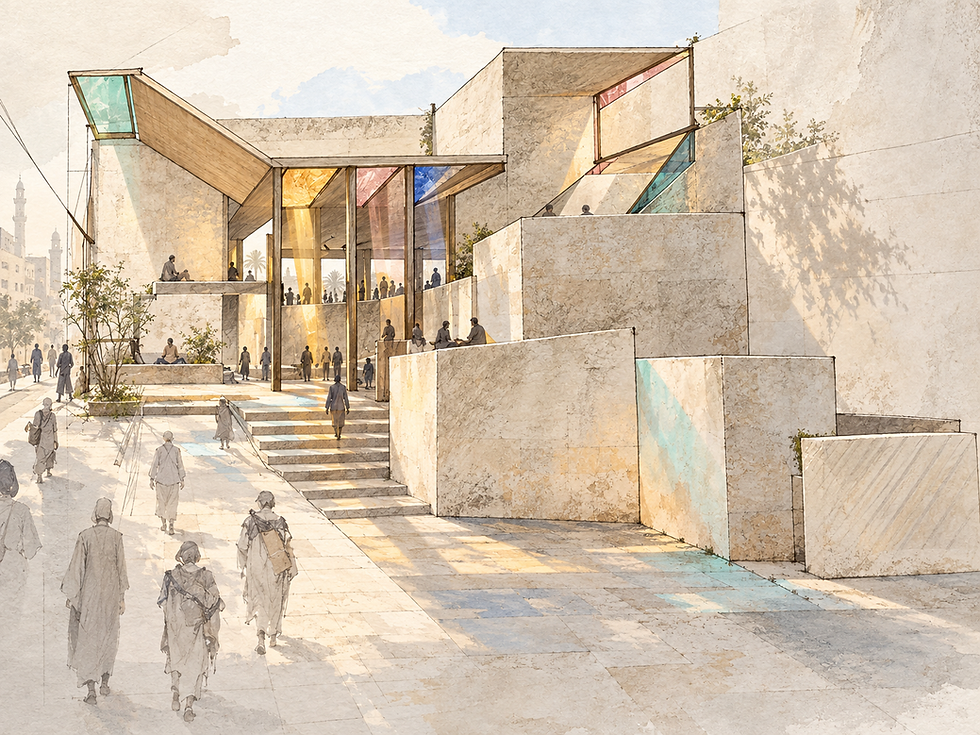
Image by Frazer Macdonald Hay
There is an uncomfortable question that architects rarely ask. What happens when the building we hoped to conserve has already disappeared? Adaptive reuse has become one of the defining architectural ideas of our age. Around the world, former factories become museums, warehouses become homes, churches become theatres, and industrial landscapes become parks. These projects are celebrated because they offer an alternative to demolition. They remind us that continuity matters, that memory has value, and that buildings can continue to contribute to society long after their original purpose has faded. Yet almost all of these projects begin with one crucial assumption: the building still exists. We have become very good at imagining new futures for old buildings. We have spent far less time considering what adaptive reuse might mean when there is nothing left to reuse.
That question stayed with me while responding to a recent design competition in Historic Cairo. The site was once occupied by Saray Sadiq Pasha, a nineteenth-century residence opposite the remarkable Bayt al-Razzaz within the UNESCO World Heritage Site of Darb al-Ahmar. After years of unsuccessful attempts to restore it, the building was demolished, leaving behind an empty plot now used informally as a car park. Competitors were invited to imagine what should stand there next. At first, I approached the site as I have approached countless conservation projects before, searching for an architectural response. Yet after several days of sketching, I realised I had become trapped by the wrong question. Rather than asking what should be built on the site, I found myself wondering something altogether different. What kind of room had the city lost?
That seemingly small shift transformed the entire project. Instead of treating the site as an isolated parcel of land awaiting development, I began to think of Darb al-Ahmar itself as the host. Adaptive reuse has always been described through the relationship between an existing building and a new intervention. But perhaps that relationship can exist at a different scale. Perhaps the host is not always a building. Perhaps the host can be a neighbourhood, a street, or even an entire city. The Saray had disappeared, but Historic Cairo remained. Its streets still carried artisans to their workshops. Its courtyards still echoed with conversation. Children still played football in narrow alleyways. Tea was still served in cafés. Visitors still wandered slowly beneath centuries of layered architecture. The host had not vanished. It had simply become larger.
Once I began to think in those terms, I no longer wanted to design another building. I wanted to furnish the city. The proposal, which I called The Urban Room, was conceived less as an architectural object than as a carefully crafted piece of civic furniture. Furniture does not dominate the room it occupies. It supports life within it. It offers somewhere to rest, to gather, to work, to converse or simply to remain. That felt like a more appropriate ambition for such an extraordinary place. Rather than competing with Bayt al-Razzaz or attempting to recreate the lost Saray, the intervention would quietly complete an unfinished sentence within the city, creating another room within the much larger house that is Historic Cairo.
This also changed the way I thought about design itself. Architects are often trained to organise buildings around functions. We ask where the café should go, how large the exhibition space should be, or how visitors should circulate. Those questions are important, but perhaps they come too early. For this proposal, I tried to design around experiences instead. Where should someone first encounter shade after leaving the brightness of Bab al-Wazir? At what moment should the noise of the street begin to soften? Where might two strangers naturally begin a conversation? Where should a child first notice the extraordinary timber windows of Bayt al-Razzaz rather than the new intervention itself? The architecture gradually became less about programme and more about choreography. Its purpose was not simply to contain activity, but to shape the quality of human experience.
The longer I sat with these questions, the more I realised that the most important things happening in Darb al-Ahmar were not architectural at all. They were profoundly ordinary. A craftsman carrying timber through the street. An elderly neighbour stopping for tea. Children weaving effortlessly between workshops. The sound of metal being hammered into shape. Conversations drifting from open doorways. These moments rarely appear in conservation reports or architectural drawings, yet they are precisely the moments through which places retain their identity. Heritage is not sustained by buildings alone. It survives because everyday life continues around them.
Perhaps this is something architecture has occasionally forgotten. We often describe buildings as physical assets, cultural resources or heritage objects. Those descriptions are accurate, but incomplete. Buildings are also social instruments. They create opportunities for encounter. They frame rituals that repeat across generations. They quietly influence whether people feel welcome, excluded, hurried or at ease. A well-loved library, a market, a church hall, a courtyard or a neighbourhood café may contribute as much to the resilience of a community as any officially protected monument. Their value lies not simply in their material fabric but in their remarkable capacity to host human life.
Thinking about the project also made me reconsider adaptive reuse itself. For years I have argued that successful reuse depends upon understanding the memory and identity embedded within existing buildings. I still believe that. Yet The Urban Room suggested something larger. Adaptive reuse is perhaps less about preserving individual structures than preserving relationships between people and place, between memory and change, between everyday life and the spaces that quietly sustain it. When a building disappears, those relationships do not necessarily disappear with it. They simply require a different architectural response.
That may be the deeper lesson of the empty plot in Darb al-Ahmar. Demolition does not always leave a void. Sometimes it reveals a question that architecture has not yet learned to ask. Instead of asking what should replace the building, perhaps we should ask what relationships need to be strengthened. What forms of hospitality should be encouraged? What opportunities for encounter should be created? What experiences might help the city continue its story?
The Urban Room is only one possible answer. It is not intended as a monument, nor as a reconstruction of what has been lost. It is simply an attempt to imagine how architecture might respond when conservation arrives too late. In doing so, it has led me towards a different understanding of adaptive reuse, one that extends beyond the boundaries of the individual building and towards the wider life of the city itself.
Adaptive reuse is not ultimately about saving buildings. It is about ensuring that places never lose their capacity to host human life.
Thank You – Frazer


