

Thank You, Urban Realm

I am delighted to thank Urban Realm for publishing my article, Rebuilding Without Erasing, which they boldly retitled Ghost Buildings. It is a real honour to feature in one of Scotland's leading publications covering architecture, design and the built environment.
The article explores a question that architecture rarely asks: what should we do with buildings that have been used for violence?
We are familiar with rebuilding homes, restoring infrastructure and repairing heritage after conflict. Yet there is another category of building that often slips between conventional approaches, ordinary schools, offices, churches and homes, that have become associated with acts of violence. They are too ordinary to be protected as heritage, too complex to be treated as ordinary buildings, and too politically sensitive to be confronted directly.
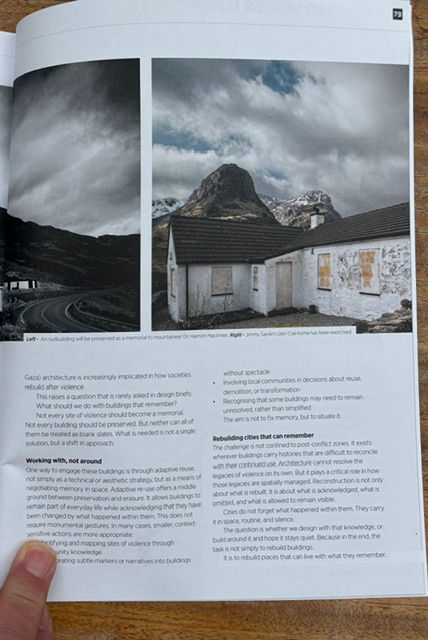
Drawing on my work in Mosul after the occupation by ISIS, and reflecting on examples closer to home, such as Dunblane and the demolition of Jimmy Savile's former cottage in Glencoe, the article argues that reconstruction is not simply about repairing buildings. It is also about deciding what societies choose to remember, acknowledge or quietly erase.
Rather than viewing adaptive reuse solely as a technical or environmental exercise, I suggest it can become a way of helping communities live alongside difficult histories without allowing those histories to dominate everyday life.
The article sits alongside an excellent edition of Urban Realm, featuring Scottish Design Award winners, landscape architecture, mass timber construction, philanthropy in housing, Scotland's growing space sector and much more. It is a publication packed with thoughtful writing about the future of our built environment, and I am grateful to have my work included among such distinguished contributors.
My sincere thanks to the editorial team at Urban Realm for giving space to this conversation. I hope the article encourages architects, planners, conservation professionals and policymakers to think differently about the buildings that remain after violence, not simply as structures to repair or remove, but as places whose memories continue to shape the communities around them.
I hope you'll enjoy reading the full article in the latest issue.


#AdaptiveReuse #Peacebuilding #CulturalHeritage #PostConflictRecovery #UrbanRecovery #Reconstruction #Architecture #BuiltEnvironment #SocialCohesion #HeritageProtection #Memory #UrbanPlanning #ConflictTransformation #ResilientCities #GhostBuildings


