

The Conversation Before the Workshop
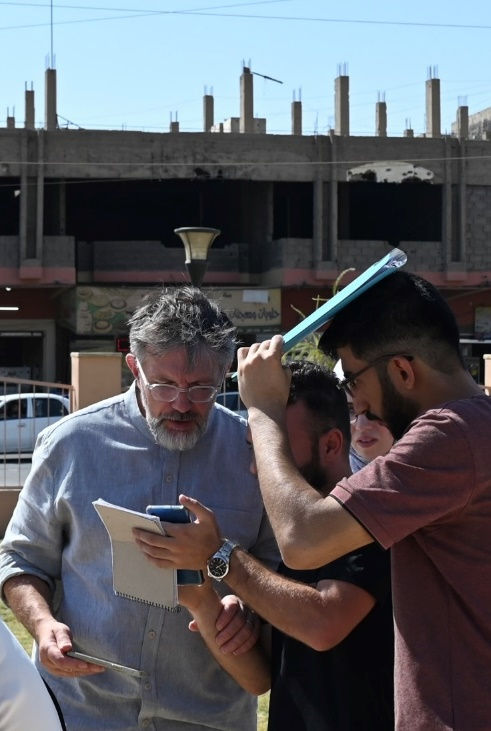
Over the past few months, I have found myself having some remarkable conversations.
Some have taken place in living rooms over coffee. Others around boardroom tables. Some have happened in Ukraine during an air raid. Others in London with leaders of international organisations, or in Scotland with people working in heritage, architecture and community development.
I've spoken with royalty, firefighters, architects, museum directors, refugees, soldiers, students, craftspeople and conservationists.
Looking back, I realised something unexpected.
The most valuable part of my work has rarely been the report, the strategy or even the project itself.
It has almost always been the conversation that came before it.
As consultants, researchers and professionals, we often convince ourselves that our value lies in having answers. We are expected to analyse, recommend, evaluate and solve problems. Increasingly, however, I have begun to wonder whether our greatest contribution is sometimes something much simpler.
Asking better questions.
The philosopher Socrates believed that dialogue was a search for truth. More recently, thinkers such as Jürgen Habermas argued that conversation is fundamental to democracy because it allows people to test ideas through openness and mutual respect. Mikhail Bakhtin went further still, suggesting that we become ourselves through conversation with others; that our thinking is never entirely our own, but shaped by the voices we encounter throughout our lives.
I suspect they were all pointing towards the same realisation.
Conversation changes us.
This week I had a long conversation with a colleague in the United States about an educational programme I have been quietly developing.
I thought I was explaining a workshop.
Instead, something rather more interesting happened.
She immediately began applying the ideas to her own world. She spoke about migration, belonging, identity, memory, wellbeing and the way our lived environment quietly conditions how we relate to ourselves and to one another. She asked questions I hadn't thought to ask. By the end of the conversation, I realised she hadn't simply understood the idea.
She had transformed it.
The workshop had become something we were building together.
That was the moment I understood that perhaps the conversations themselves were the real work.
Looking back over the past decade, I can see that this has always been true.
When I worked in Iraq with families displaced by war, the reports mattered.
But it was the conversations that stayed with me.
When I travelled across Ukraine speaking with firefighters, municipal workers and people trying to rebuild daily life under bombardment, the articles mattered.
But it was the conversations that changed how I understood resilience.
When I interviewed heritage leaders for the British Council's Cultural Protection Fund anniversary publication, I thought I was collecting stories.
What I was really collecting were different ways of seeing the world.
Each conversation quietly expanded my own.
....
Perhaps this is why I have become so interested in place.
Not because buildings are fascinating in themselves.
But because every conversation about people eventually becomes a conversation about place.
Where did you grow up?
Where did you feel safe?
Where did you fall in love?
Where did you grieve?
Where do you belong?
Every significant human experience happens somewhere.
Our first breath is taken in a place.
Our first day at school.
Our first job.
Our greatest successes.
Our deepest losses.
The places remain long after the moments have passed, quietly shaping memory, behaviour and identity in ways we rarely stop to notice.
....
The more I reflect on this, the more convinced I become that we need spaces for slower conversations.
Not debates designed to produce winners.
Not meetings driven by agendas.
But conversations that invite curiosity.
Conversations where architects speak with psychologists. Developers with artists. Refugees with planners. Game designers with historians. Business leaders with conservationists. Young people with older generations.
Not because everyone will agree.
But because every person sees something others cannot.
The richest insights often emerge when different ways of seeing meet in the same room.
....
Over the coming months, I want to have many more of these conversations.
With people from different professions, different generations and different countries.
I want to ask a deceptively simple question.
How has the place you inhabit shaped the person you have become?
I suspect the answers will tell us as much about society as they do about architecture.
Perhaps that is what I have been trying to build all along.
Not simply a workshop.
Not simply a book.
But a series of conversations that change the way we see people and place.
Because those who understand people through place gain a deeper understanding of the world.
And those who understand place through people gain a glimpse of its future.


