

Light, Warmth, and the Everyday Bravery of Ukrainian Culture
What Ukraine’s public art reveals about resilience once the celebrations are over

As the New Year settles in and the decorations come down, much of the world has already moved on from the festive season. Attention turns to priorities, plans, and the practical business of the year ahead. Yet beyond the glow of celebration, not everyone has had the luxury of pause or reset.
For Ukrainians, there was little or no festive interlude. No collective exhale. No safe distance from loss, fear, or responsibility. Loved ones are dead, injured, missing, or on the front line. Many are grieving, traumatised, or anxiously contemplating mobilisation. The future is not welcomed with champagne and resolutions, but negotiated day by day under unimaginable pressure.
And yet, within this sustained confrontation with violence, Ukrainian culture continues to speak. Not loudly. Not triumphantly. But with care, intelligence, dignity, and an understated humanity that resists both despair and spectacle. As many elsewhere now look forward to a new year, that contrast remains unresolved.
Recently, Olena Hantsyak (Co-founder and Head of the Ukrainian Nonviolent Communication Centre DignitySpace) shared with me two public art installations in Kyiv. Together, they offer a revealing glimpse into how creativity, labour, and resilience intersect in wartime Ukraine.

The first is The Tree of Light, unveiled near St Sophia Square in December. Created by DTEK, Ukraine’s largest private energy company, in collaboration with Zavertailo and Honey, it resembles a familiar Christmas tree, until one looks more closely.
The structure is built entirely from the real protective workwear of Ukrainian energy workers: the men and women who restore electricity after missile and drone attacks on power infrastructure. In today’s Ukraine, light is no longer a passive background condition. It is contested, targeted, and repeatedly repaired under fire.
Energy infrastructure has become a frontline. Power is often restored only to be destroyed again. Hospitals, homes, and entire cities depend on workers returning again and again to damaged networks, fully aware of the risks involved.
The installation is dedicated to those workers, but its message extends far beyond them. It expresses gratitude to all Ukrainians who continue to function, support one another, and hold everyday life together amid prolonged blackouts and constant uncertainty.
The creators describe the work simply: darkness is a reality, but light is a choice. As long as people continue to “shine,” darkness does not prevail.
There is no spectacle here, and no denial of suffering. Instead, the installation quietly reframes what resilience looks like when survival itself becomes an act of resistance.
The second installation is far simpler: a cube of ice bearing the words,
"Ice around the heart can only be melted with the warmth of your touch.”
In a country where grief is cumulative and emotional numbness is an understandable defence, the gesture feels profoundly humane. It does not demand optimism or reconciliation. It does not insist on forgiveness or forgetting. It acknowledges emotional freezing as a rational response to trauma, while quietly insisting that connection still matters.
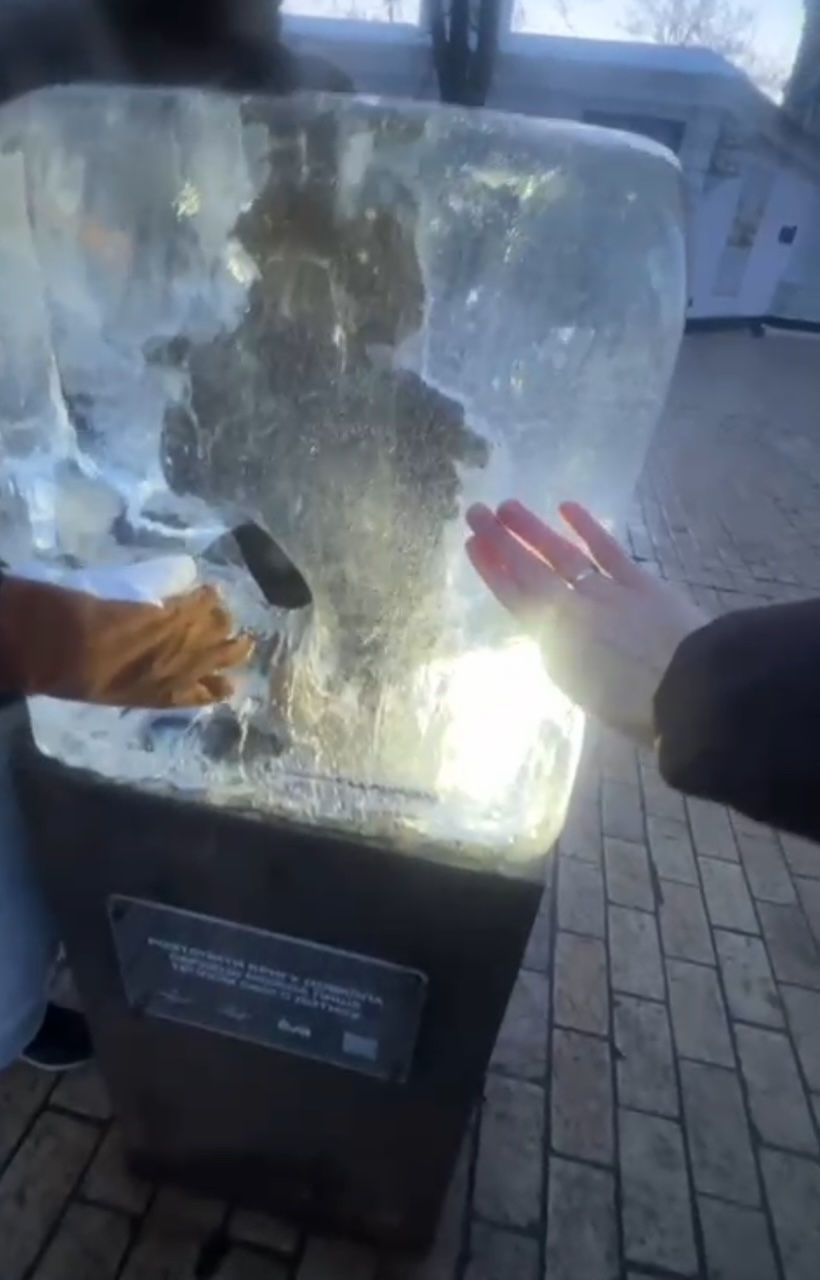
Warmth, here, is not abstract or symbolic alone. It is relational. It requires proximity, care, and risk.
Taken together, these installations are not grand statements about victory or national identity. They are moments (punctuation marks) of humanity within an everyday shaped by inhumanity.
They show how art, resistance, and resilience are not separate domains, but intertwined practices. How creativity persists not despite pressure, but through it. How care, humour, and symbolic intelligence continue to circulate even when circumstances would justify their absence.
Crucially, these works resist novelty. As the calendar turns and attention shifts elsewhere, they remind us that endurance does not reset with the New Year, and neither does responsibility.
This is not cultural production as distraction. It is cultural production as maintenance: of dignity, of meaning, and of social bonds under sustained strain.
At a time when much of the world has celebrated, rested, or reset, Ukraine continues to endure. And within that endurance, its culture continues to speak, not through grand declarations, but through light built from workwear, and ice that asks to be touched.
If these gestures teach us anything, it is that solidarity is not measured by moments of attention or seasonal statements. It is measured by consistency, by willingness to stay present once the headlines fade. As Ukraine enters yet another year under pressure, the question is not whether its people remain resilient (they already are) but whether the rest of us remain willing to stand with them.


